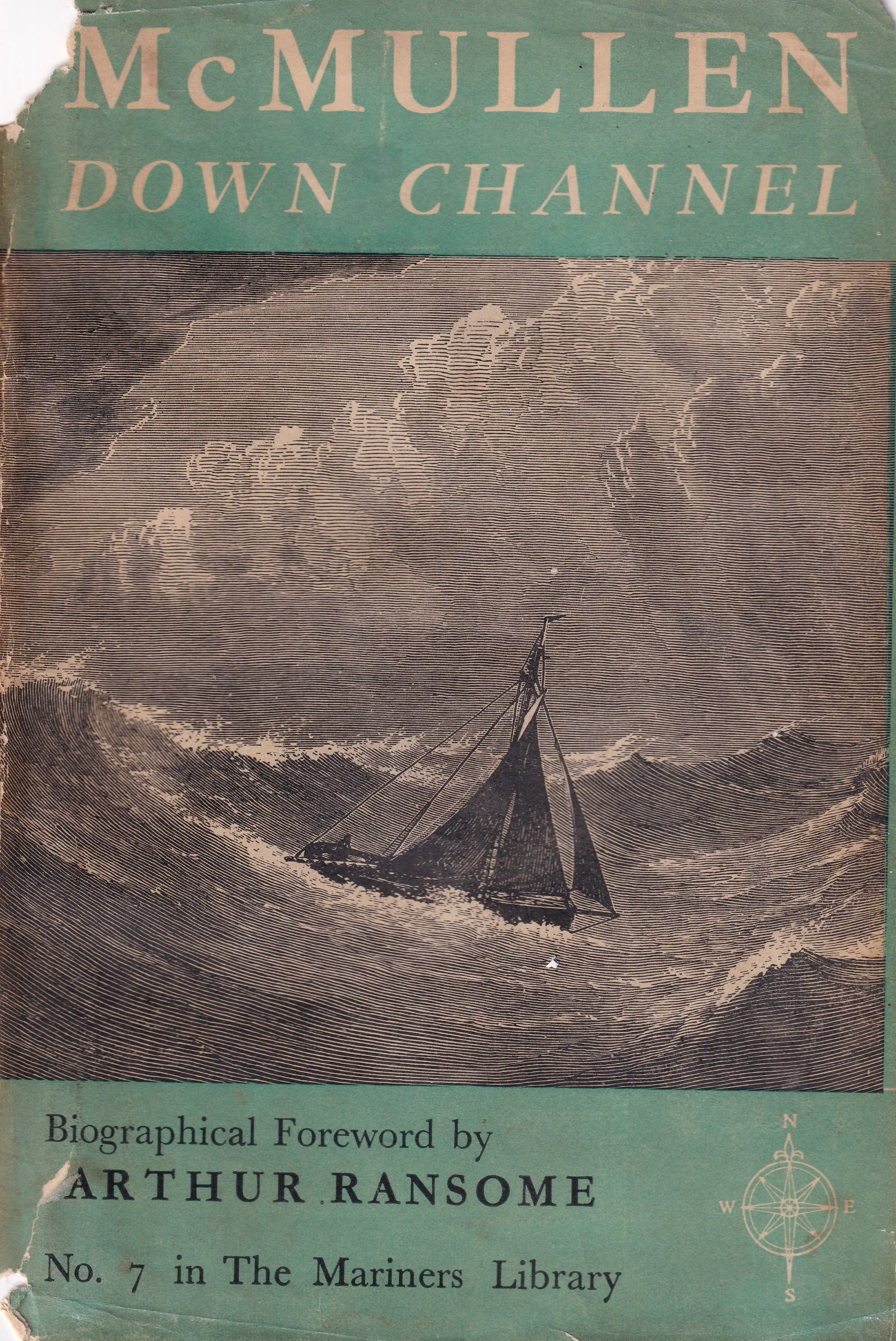
Down Channel - RT McMullen
From Yachting Monthly Summer 2026 - Issue #1456
In this issue, Julia selected RT McMullen's classic Down Channel as her Book at Bunktime. Thus was first published in 1869 It was a book that had sat on her selves for a long time but had always looked a trifle forbidding. She used the Mariners Library edition with introduction by Arthur Ransome. There's social interest in the difficult relationships between McMullen and those he pays to sail with him (two of whom eventually leave, forcing him to sail alone, which he achieves with panache). The main, undeniable fascination however, is McMullen's sheer courage as he sails the difficult waters of the channel in a variety of small boats. One with as little as 9" freeboard! Richard McMullen was born in 1830 and died in 1891 -- at the tiller.
Julia reviewed Lifeboat at the End of the World by Dominic Gregory, No Quitting by Andrea Barker and the new edition of the Shell Channel Pilot, edited by Rachel Sprot.
The Charity of the Month was Jonathan Brewin's Round Britain fund raising voyage for BBC Children in Need, shipping Pudsey Bear with his as a crew mate. www.justgiving.com/page/jonathan-brewin-1
Chance Encounter / Lost off the Lizard
McMullen and his young crew, George Chason, left Greenwich on June 10th 1857 and sailed down channel in the tiny ‘model yacht’, Leo. After spending some weeks exploring the south coast of Cornwall, McMullen was determined to round the Lizard and reach Land’s End.
August 10 1857 Sailed from Coverack. 7:30 AM; wind SW fresh and fine. 11 AM, with best topsail set, went into the Race off the Lizard Point. Having been advised by pilots to avoid the Race as much as possible by keeping close to the rocks, I endeavoured to follow out their instruction but took fright at the breaking sea and bore up into the middle of it. As it had been blowing hard from the westward for three days, a great swell was rolling in from the Atlantic, and in the Race it was such a tremendous sea that neither the boy nor myself could look outside the boat after the first few minutes without turning giddy. Sitting on a deck 9 inches above water, with a rail only 4 inches high interposing, the nakedness and insignificance of the boat were so apparent that the effect was overwhelming to the senses. I felt, besides, the wretched, weakening sensation in the spine which most people feel when tossed in a high swing against their will.
It was a relief to get out of the Race into the long, regular roll of the Atlantic, which is more seen than felt in a small vessel. 3 PM. Hove to off the Runnel Stone upon which the sea was breaking high and green. Having had a good look at the Land's End and the Longships, we bore up and ran for Penzance, arriving at 6 PM.
In one of the Harbour books containing an account of dues received, may be seen under the date of August 10, 1857, the Leo, 3 tons, of London, McMullen master and owner, 6d. Which sum was not demanded of me but was paid by the quaymaster and entered for curiosity.
There is a wonderful difference between being outward bound for pleasure and homeward bound of necessity: a remark that will apply to many things besides sailing. The first being voluntary, and the second in a measure compulsory, the pleasure is proportionate to the conditions.
At Penzance, it struck me forcibly that we were a long distance from Greenwich, in a very small ship, and the sooner we got on the other side of the Lizard, the better. After leaving Penzance there is no harbour for 35 miles, and, though I knew there was a great swell up and dreaded the Race, it was in my opinion better to go through it at once, than to wait and run the chance of worse -- especially as the days were drawing in and the long nights coming on. I could have spent a week very agreeably in Mount’s Bay but dared not linger longer than was necessary to get provisions and water.
August 11. Sailed from Penzance 11 AM and turned against light, baffling winds to the Lizard which, with the swell rolling the wind out of the sails, delayed us so much that it was sunset when we got to the Race off the Point. As there was not wind enough to give steerage way in so great a commotion, we had to get oars out to keep before the sea, which invaded the deck several times, and tumbled and roared so that I feared we were amongst the rocks. The tide being nearly spent, it was pretty certain we should be driven back through the Race in the dark unless an anchorage could be found. Not having contemplated such a contingency as being benighted in a calm at the Lizard, I had taken no pains to make myself acquainted with the details of the chart and was therefore utterly unprepared with any plan except that of keeping the sea, which I should have been content to do but for that horrid Race. The prospect was anything but cheering when, chancing to see a cutter helplessly plunging and rolling about 1/2 mile off, we pulled towards her and asked the men to direct us to an anchorage. It was delightful to hear that they were going in shore to bring up, and that we only had to keep company. Having got out their long oars we rowed in side by side at the distance of one sea apart, now in full view of each other, and now out of sight with the sea between, when only the masts were visible. A conversation carried on under such circumstances was necessarily of a desultory nature, and full explanations had to be deferred until anchors were let go in Perren Vose Cove, and our new acquaintances came alongside in their boat.
I then learned that their vessel was a tailor’s cutter belonging to Falmouth, and their business was boarding homeward bound ships to supply new clothes to those who preferred walking ashore in a new suit to being seen in sea-stained garments. In fact, their business was to steal a march upon advertising, in which I hope they were entirely successful, for a more civil set of men I never chanced to meet.
With great regret I heard of the death of the Captain in a gale on the 22nd August, 1868. They were at anchor in Coverack Cove when the wind setting in furiously from the SE compelled them to run for Falmouth. Off the Manacles the sea broke on board and swept the Captain from the helm. (At the time this occurred, which was early in the morning we were in great alarm in Tor Bay where the wind likewise blew onshore.) I well remember the Captain’s parting injunction when pushing off from the side to the Leo, ‘If the wind should come from the SE, get underway as soon as possible and go out to sea.’
Author bio: Richard Turrell Mc Mullen (1830–1891) was a pioneer of small boat cruising, including single-handed. His first yacht, the Leo, was a 20-foot half-decked 3-ton cutter, with minimal freeboard. She was followed by the Sirios, Orian and Procyon. He died at sea aboard the 6-ton lugger Perseus sailing alone for France with his hand still on the tiller.