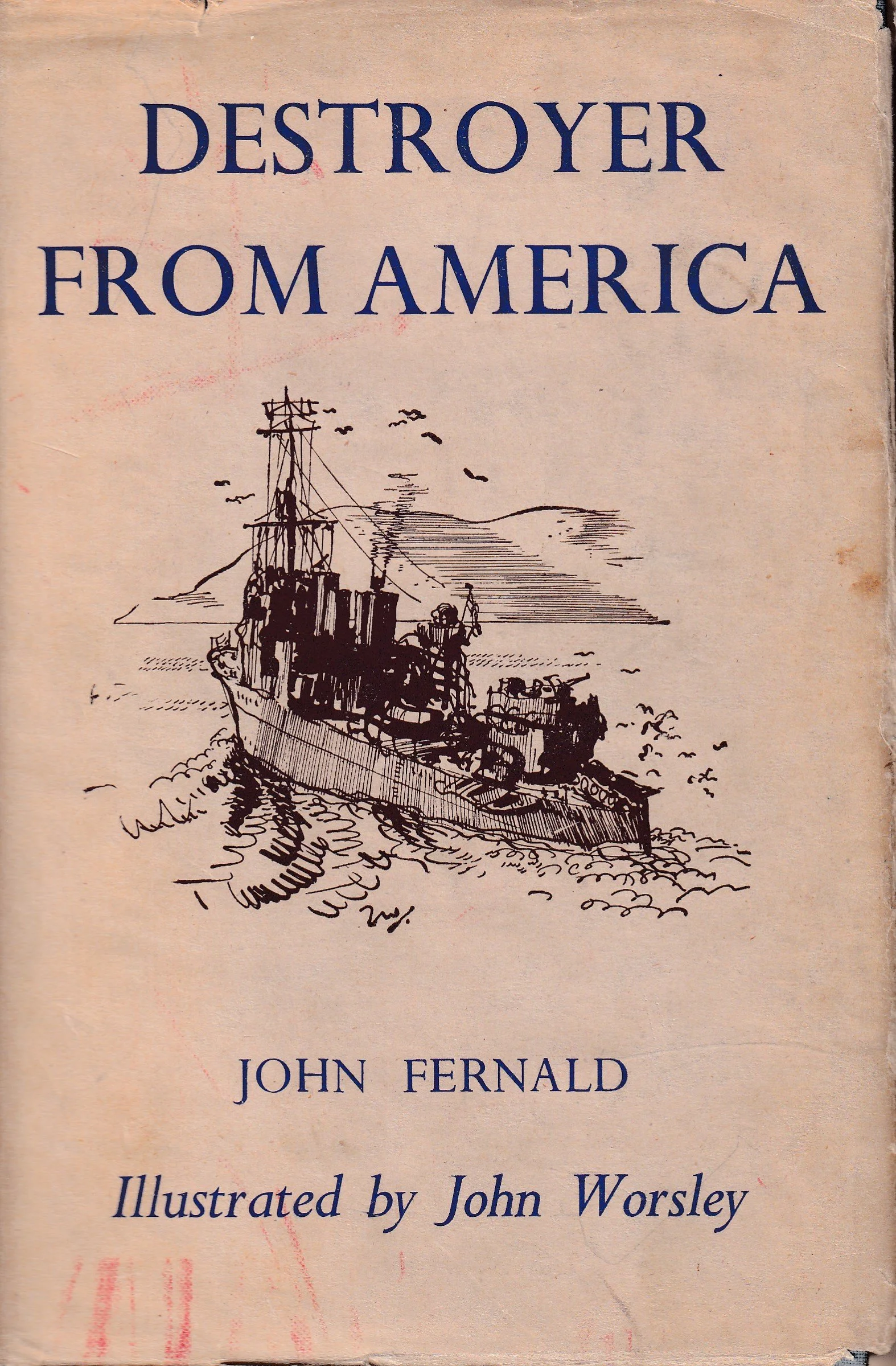
Destroyer from America - John Fernald
From Yachting Monthly July 2026 - Issue #1455
In this issue, Julia selected Destroyer from America (1942) by John Fernald as her Book at Bunktime -- thanks to Cruising Association member Jules Dussek for the recommendation.
The author served on one of the American 'Liberty' destroyers during WW2, including a period on Atlantic Convoy duty. This book was written at that time (note the publication date) and is lightly fictionalised -- for instance the author's name and destroyer's name have been changed. It's not a 'gung-ho' war book as the author emphasises the frequent monotony of war as well as the squalid living conditions.
His background as a yachtsman is clear as well as his admiration for the stoic professional seaman who commanded the ship. John Fernald (1905-1985) was already a successful actor and playwright before he volunteered for the RNVR. After the war he continued his career in film, TV and theatre, including becoming principal of RADA
The destroyer HMS Porchester is on convoy escort duty. One of the merchant ships in their care has been torpedoed. They fear she is lost. They pursue and destroy the enemy U-boat, then return to see what can be salvaged.
‘There she is.’
The lookout had forgotten his naval parlance in his excitement. Yes. There was Saratoga on the starboard bow, not so very far away after all, and she was still afloat. There would be time. There would be time.
Porchester scudded along. A huge black cloud of smoke mingled with shooting sparks, streamed off out of her two forward funnels -- the chief had clearly forgotten himself -- but the captain took no notice. The Saratoga grew nearer, and as she appeared in greater detail the Navigator noted that she had not lowered any boats. Yet she was further down by the stern than she had been when the Porchester had left her... Yes, all her port boats still hung tightly in their outboard seagoing positions: her starboard side, of course, could not be seen, for in her helpless condition she had swung beam on to the wind, which still blew hard from the north. The sea was too heavy, thought Harker, for lowering boats except in dire emergency but in this situation, any risk would be worth taking. Why then, had no apparent effort been made to leave the vessel? Even the quick release rafts on the shrouds, which could be launched in any sea, were undisturbed.
‘We’ll signal,’ said the Captain. ‘Signalman! Make: “Are you abandoning ship?”’
Porchester’s signalman sprang into the lamp platform and quickly rattled his shutters. The destroyer slowed down to 5 knots. The Saratoga was now rolling heavily, about four points off the starboard bow less than half a mile away. The answer came back with unexpected suddenness:
‘I'm not abandoning.’
‘Obstinate devil,’ said the Captain. ‘I knew he was a devil. The moment I first saw him at the conference.’
[The Captain makes up his mind to take the Saratoga in tow.]
Tow them! Admittedly, the two ships were only about 150 miles from home. In reasonable weather, such a proposition would be reasonable enough but in such a wind and sea how was the towing line to be got across to the disabled ship? Boats were out of the question. And for Porchester to approach closer than about fifty yards would be highly dangerous since the destroyer was not, at slow speeds, easily manoeuvrable, and the slightest error of judgement might allow the swell to take hold of her and smash her fatally against the merchant ship’s side. Fifty yards -- no sailor alive could throw a heaving line that distance. What then, was to be done?
It was characteristic of the Captain that already, before the solution of the problem was even found. Porchester’s signalman was flashing the following message:
‘To Saratoga from Portchester. Shall take you in tow. Will signal instructions shortly.’ […]
[The Portchester has not been provided with a Schermaly pistol. Instead the captain devises a complex plan to tow two casks on long light grass ropes made fast to sixty fathoms of 4 ½” wire.}
As Porchester bore down on the merchant ship the Navigator began to understand what the captain was proposing to do. He was going to pass close to Saratoga's lee and then to cut diagonally across her bow to windward, relying on his helmsmanship to bring the two buoys scraping along her starboard bow plates -- an operation calling for the highest degree of skill and judgement. The Saratoga’s crew were to grapple for the grass ropes and haul them aboard, the temporary turns on Portchester’s quarter bollards would be cast off and the destroyer’s wires would run out through the fairleads and be heaved up by means of the grass ropes onto the merchant ship’s fo’c’sle. The success of the evolution depended on the exact moment at which the Captain put his helm over and how near the Saratoga’s starboard side he was going to dare to pass.
It seemed he was going to cut it pretty fine. Already as telegraph rang Dead Slow, the destroyer’s stem was less than sixty yards off. The after part of the ship -- for that was all it could be called -- came abreast of the bridge. It was an extraordinary sight: the high poop had been blown clean off and the deck, from abaft the main mast, simply slanted straight into the sea like a shelving beach. But from that point forward the appearance of the ship seemed perfectly normal, except that since she was so heavily down by the stern, she was of course abnormally high in the bows. She had been quite incredibly lucky: had she been struck even a few feet further forward that would certainly have been the end of her. Her boat deck now came abeam; a little dog was running along it, wagging its tail and barking; then the two bridges were abreast each other, and from Saratoga's a lean, elderly man with spectacles gravely took off his cap and waved it at Lieutenant Commander Broadstairs.
‘Good afternoon,’ answered the Captain of Porchester as if he had just met a friend on the golf course.
On the steamer’s fo’c’sle, the First Officer and the Boatswain, were ready. each with three hands and grappling lines. ‘Going fishing?’ shouted somebody from the destroyer and the men on the Saratoga grinned.
Author bio: John Fernald (1905-1985) was a distinguished actor, playwright and producer who volunteered for the RNVR during WW2. Previously he had been a weekend yachtsman, then from service at Dunkirk until he was demobbed in 1945 he was almost continuously at sea. 1941-1942, when he was just married, he was posted to the American ‘Liberty’ destroyer HMS Newmarket on Atlantic convoy duty. Destroyer from America is a lightly fictionalised account of that period.